
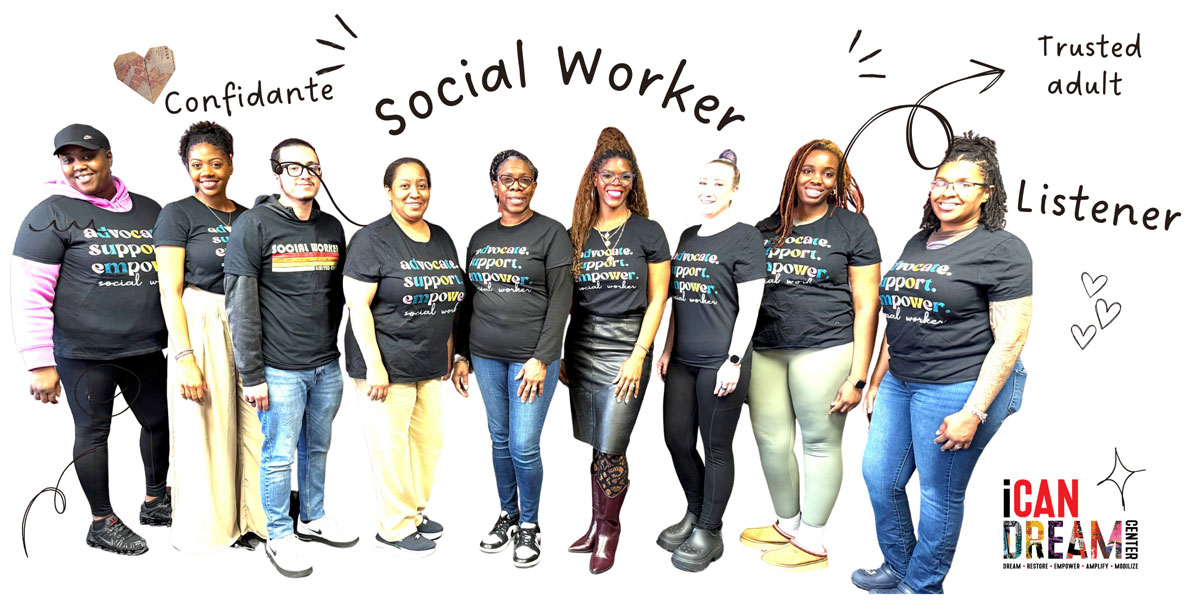
The Heart of Belonging: Why Social Workers Matter at iCan Dream Center
At iCan Dream Center, we often talk about belonging — not as a buzzword, but as a lived experience. It’s the feeling a student gets when they walk through our doors and know, without question, “I am safe here. I matter here. I belong here.”
Behind that feeling, every single day, are our social workers.
They are the steady presence in the building. The ones holding stories that are too heavy for young people to carry alone. The ones who see beyond behavior and into the why. The ones who quietly, consistently, make everything else possible.
Seeing What Others Might Miss
Our students are bright, capable, and full of potential. Many are navigating ADHD, autism, anxiety, trauma, or complex life circumstances that don’t always show up neatly on a schedule or in a classroom.
A social worker sees the student who shuts down and recognizes overwhelm, not defiance.
They see the student who jokes constantly and recognize masking, not misbehavior.
They see the student who’s absent — and ask what’s happening outside of school.
At iCDC, social workers help us shift the question from “What’s wrong with this student?” to “What has this student experienced, and what do they need right now?”
That shift changes everything.
The Bridge Between School, Home, and the World
Social workers are connectors.
They sit with families during some of their most vulnerable moments — navigating diagnoses, transitions, fears about the future, and the very real question of “What happens after high school?”
They translate systems that feel overwhelming.
They advocate when families feel unheard.
They ensure no one is walking this journey alone.
At iCan Dream Center, this bridge is critical. Because our work doesn’t stop at the classroom — it extends into homes, workplaces, and the broader community. Social workers are often the thread that keeps it all connected.
Regulating Before Educating
Learning doesn’t happen when a nervous system is in survival mode.
Our social workers understand this deeply.
They are often the first call when a student is dysregulated — not to remove them, but to support them. To co-regulate. To help them breathe, reset, and return. To teach skills that last far beyond a single moment.
They help students name emotions, build coping strategies, and begin to understand themselves in ways that are empowering rather than limiting.
In doing so, they don’t just help students get through the day — they help them build the foundation for a lifetime.
Protecting Dignity and Building Identity
Adolescence and young adulthood are about identity — figuring out who you are and where you fit.
For many of our students, that journey has been interrupted by labels, exclusion, or environments that didn’t fully understand them.
Social workers help rewrite that story.
They remind students:
- You are not your diagnosis.
- You are not your hardest day.
- You are capable, worthy, and needed in this world.
They hold space for grief, for frustration, for hope — and help students begin to see themselves not as “behind,” but as becoming.
The Invisible Work That Changes Everything
Much of what social workers do is unseen.
It’s the quick check-in in the hallway.
The quiet conversation before a meltdown escalates.
The phone call home that reassures a parent.
The collaboration with teachers to adjust supports.
The moment a student says, “Can I talk to you?” — and knows the answer will always be yes.
This is not small work.
This is transformational work.
Why It Matters — Now More Than Ever
In a world where youth mental health challenges are rising, the role of social workers is not optional — it is essential.
At iCan Dream Center, they are not an add-on. They are the heartbeat of our model.
They make belonging real.
They make growth possible.
They make it safe for students to show up as they are — and to dream about who they can become.
And in a place built on dreams, that may be the most important work of all.