
They Didn’t Change. We Finally See Them.
There’s something happening right now that we have not talked about yet here on the blog.
Students are walking into spaces like iCan Dream Center with a language for themselves that didn’t exist—even five years ago. Not clinical language. Not labels handed to them. Real language. The kind that sounds like, “This is why that feels overwhelming,” or “This is why I’m exhausted at the end of the day.”
And more often than not, that understanding didn’t come from a textbook.It came from someone they saw on TikTok. Or a post on Instagram. Or a creator who simply said, “This is what it feels like to be me.”
For a long time, autism was presented in a very narrow way. If you didn’t fit that picture, you were missed. Especially if you were doing well enough academically, quietly overwhelmed instead of outwardly disruptive, or masking your way through the day. Especially if you were a girl.
So many students lived in that in-between space—where they weren’t fully understood, not fully supported, and definitely not feeling like they belonged.
What’s changed isn’t autism. It’s access. Access to stories. Access to language. Access to people who are saying the quiet parts out loud.
Creators are talking about the exhaustion of masking all day in school. They’re naming sensory overload that gets mistaken for behavior. They’re describing the mental load of constantly trying to decode social expectations. And for someone watching—maybe questioning, maybe just feeling different without knowing why—those words land in a way nothing else has.
You can almost see the moment happen. Oh. That’s not just me.
That moment matters more than we give it credit for.
At iCan Dream Center, we double down on belonging as an outcome. We know that when a student begins to understand themselves, everything shifts. They stop internalizing failure. They start asking for what they need. They begin to rebuild confidence that has been chipped away over time.
And that shift doesn’t start with a program. It starts with recognition. Sometimes from a teacher. Sometimes from a social worker. Hopefully, from a parent who is also slowly beginning to learn. And increasingly, we are all learning from a stranger on the internet who told the truth about their own experience.
When that recognition is met with the right environment, something even more powerful happens. Students don’t just understand themselves—they begin to step into their strengths.
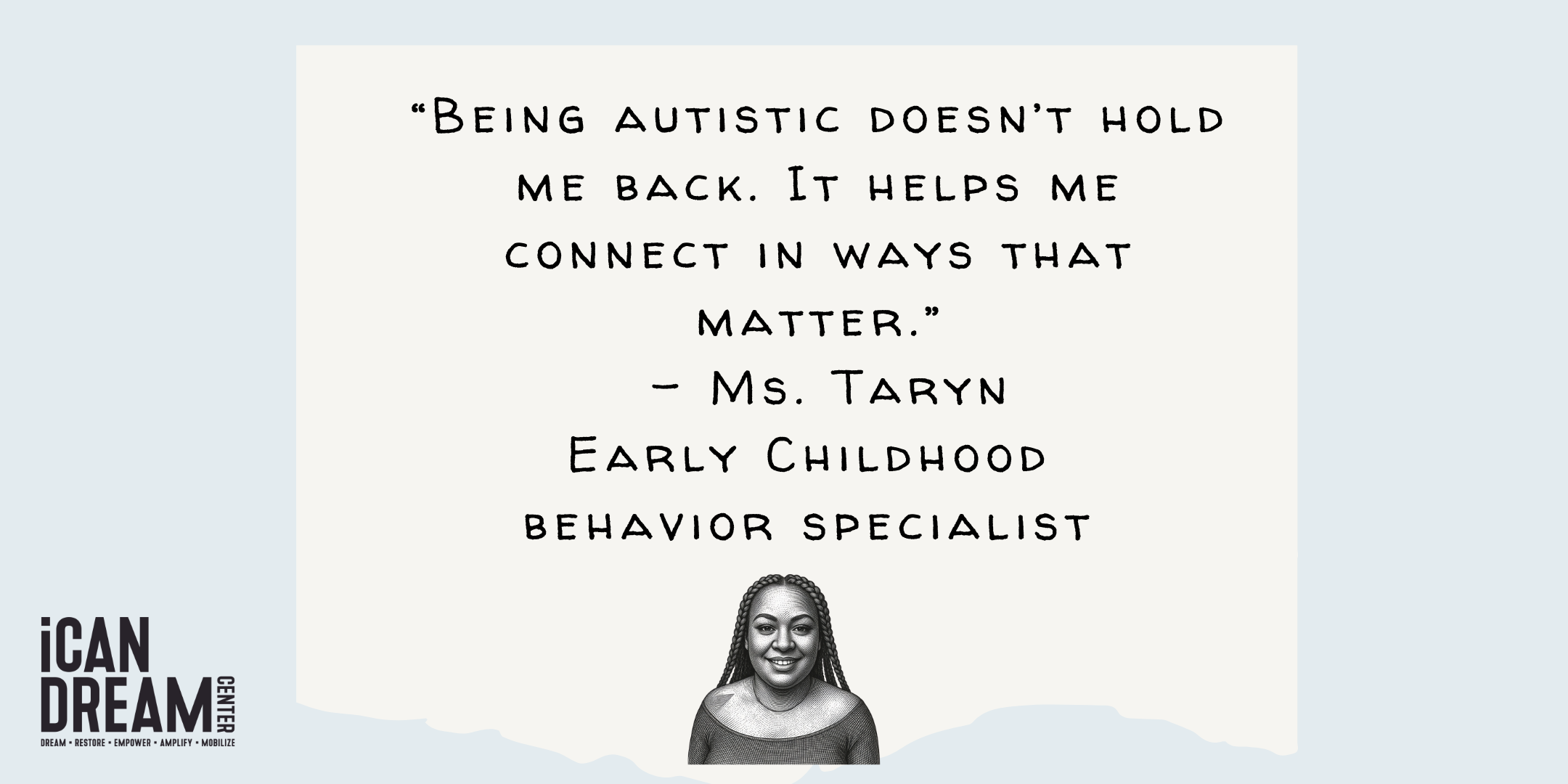
We see that in Taryn.
She’s a former student and now a colleague. Today, she works as a behavior specialist in our early childhood program and is a phenomenal teacher’s assistant. The way she connects with students isn’t something that exists in spite of who she is—it’s because of it.
As she puts it, “Being autistic doesn’t hold me back. It helps me connect in ways that matter.” That’s the shift we’re living in.
Not fixing. Not minimizing. Not trying to make students fit into a narrow definition of success. But recognizing that difference can be a bridge—not a barrier.
Of course, social media isn’t perfect. There’s oversimplification. There’s misinformation. There are moments where complex experiences get flattened into something easier to consume.
But even with that, something meaningful is happening.
People who never saw themselves in traditional narratives are finally being reflected back. And for many students, that reflection is the first step toward self-advocacy, connection, and a sense of identity that feels whole—not broken.
So the question for us becomes: are we ready to meet them there? Are we listening? Are we adjusting? Are we creating environments where understanding actually leads to support—and to opportunity? Because awareness alone doesn’t change outcomes. But understanding, when it’s paired with the right environment, does.
Autism didn’t suddenly become more common. It became more visible. And with that visibility comes something incredibly powerful—students who no longer feel like a mystery to themselves. Students who begin to understand that they are not too much or not enough. They are simply different in ways that deserve to be understood.
And when that understanding is met with the right space, they don’t just grow. They lead. They contribute. They connect in ways that matter. Just like Taryn.