
When the Game Stops Being a Game
What Every Parent Should Know About Gaming, Gambling, and the Road Between Them
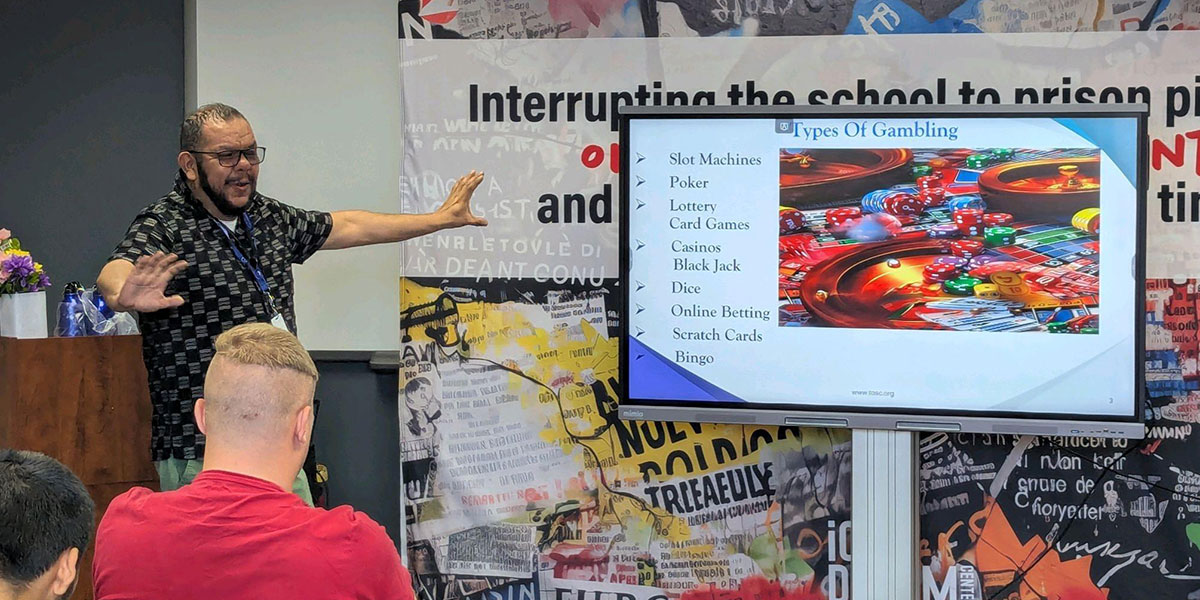
The iCan Dream Center in Tinley Park, Illinois, decided this conversation belonged on its campus. Rather than leave families to sort through it on their own, the center invited Alejandro Lopez of TASC Youth and Family Support Services to come in and speak directly about the danger of addiction and how gaming becomes a gateway to it.
He did not come to frighten anyone. He came to give our emerging adults language. Because the thing about addiction is that it almost never announces itself. It arrives as something ordinary. Something fun. Something everyone else is already doing.
Addiction Rarely Starts Where You Are Watching
Most parents are watching for the obvious things. The substance. The bottle. The behavior that would show up on a report. Meanwhile the pattern is forming somewhere far less alarming, on a screen, in a bedroom, in a house where everything looks fine.
Addiction is not really about the object. It is about the loop. Something delivers a reward. The brain notices. It wants the reward again. Over time it needs more of the thing to get the same lift, and the ordinary parts of life start to feel flat by comparison. That loop does not care whether the reward came from a substance, a slot machine, or a screen.
Which is why the question is not whether your child is gaming. Nearly all of them are. The question is what the game is teaching the brain to want.
What Turns a Game Into a Gateway
Games have changed. The game your child is playing may look like the ones you remember, but underneath it is running mechanics borrowed directly from the gambling industry.
- Loot boxes and mystery pulls. You pay, you open, you do not know what you get. That is the structure of a slot machine with better graphics.
- In-game currency. Real money becomes coins, gems, or points. Once the money changes form, it stops feeling like money.
- Variable rewards. The payoff comes on an unpredictable schedule, which is the single most habit-forming reward pattern we know of.
- Skins, trades, and resale markets. Items with real cash value get bought, sold, and wagered between players, often outside the game itself.
- Streaks, dailies, and timed events. The game creates a cost for stopping. Log off and you lose something.
- Sports betting ads inside gaming and streaming spaces, where the leap from playing to wagering is one tap wide.
None of this is an accident. These systems are engineered by people who study attention for a living. A young person is not weak for getting caught in one. They are responding exactly the way the design intended.
Why This Deserves Extra Attention in Our Community
For many of our scholars, online spaces are genuinely good. A game can be the place where the social rules are finally clear, where the sensory environment is controllable, where competence is visible and earned, where a young person who struggles to be understood in a hallway is respected in a lobby.
That is worth protecting, and it is also exactly why we pay attention. When a space is that valuable, losing access to it feels enormous, and anything happening inside it carries more weight. Add the reality that money handled through a screen is abstract by design, and the risk is not that our young people are careless. It is that the pull is stronger precisely because the place matters more.
So the goal is never to take the world away. The goal is to walk into it with them.
What Parents Can Actually Watch For
You are not looking for a single alarming moment. You are looking for a direction of travel.
- Money that does not add up. Missing gift cards, unexplained charges, requests that come more often and grow larger.
- Secrecy that is new. Screens that flip over when you walk in, accounts you did not know existed.
- Escalation. What satisfied them last month does not satisfy them now.
- Mood that tracks the outcome. Big highs after a win, a crash after a loss, irritability when they cannot get on.
- Things falling away. Sleep, school, food, the friend they used to see in person, the activity they used to love.
- Chasing. Playing or spending to recover what was lost rather than for the enjoyment of it.
One of these on its own is adolescence. Several of them together, moving in the same direction, is a pattern worth naming out loud.
What To Do Before It Becomes a Crisis
Start the conversation early, and start it curious. Ask what they are playing and let them show you. A young person who has been asked about their world is far more likely to tell you when something in it goes wrong.
Name the mechanics rather than the morals. You are not telling them the game is bad. You are showing them how it is built to keep them. Young people are remarkably quick to resent being manipulated once they can see it happening.
Keep money visible. No stored cards on the console. Purchases go through you. Not as punishment, as friction, because friction is what interrupts an impulse loop.
Agree on limits together and put them in writing before there is a conflict, including what happens when a limit gets broken. Rules written in calm hold up better than rules invented in anger.
And if the pattern is already there, do not wait for it to resolve itself. Talk to a professional. The National Problem Gambling Helpline is free, confidential, and available at any hour at 1-800-MY-RESET. The former number, 1-800-522-4700, also remains active. Families can also reach out to TASC Youth and Family Support Services or to a licensed provider in their area.
Where the iCan Dream Center Fits
The iCan Dream Center is a therapeutic day school serving neurodiverse learners. It does not provide addiction treatment or recovery services, and it does not pretend to.
What the center does is open its doors to qualified voices so that our team and students hear accurate information early, from someone who works with this every day, before anyone is in crisis. That is what hosting Alejandro Lopez was about. Not a program. A shared vocabulary.
Once a family has language for something, they can see it coming.
Key Takeaways
- Addiction is a loop, not an object. The same reward pattern drives substances, gambling, and gaming.
- Many modern games run gambling mechanics under the hood, including loot boxes, in-game currency, and variable rewards.
- Online spaces are often genuinely valuable for neurodiverse young people, which is a reason to stay close rather than to shut them out.
- Watch for direction of travel, not one bad night. Money, secrecy, escalation, mood swings, and chasing losses are the signals.
- Friction beats surveillance. Visible money, written agreements, and early conversation do more than monitoring software.
- The iCan Dream Center hosted Alejandro Lopez of TASC Youth and Family Support Services to educate its community. The center is a school, not a treatment provider.
Frequently Asked Questions
Is gaming itself harmful?
No. Most young people play without developing a problem, and for many the social and cognitive benefits are real. The concern is with specific mechanics inside some games that mirror gambling, and with the pattern that forms when play starts serving as escape rather than enjoyment.
My child does not gamble. Why should I care about this?
Because the pathway usually runs through something that was never called gambling. A young person who has spent years paying for unpredictable rewards has already practiced the behavior. Sports betting and casino apps are simply the same loop with fewer graphics and higher stakes.
What is the right age to have this conversation?
Earlier than feels necessary. If your child is spending inside a game, the conversation is already relevant. It is far easier to explain how a system works before it has taken hold than to argue about it afterward.
Should I just take the games away?
Removal alone rarely works and often costs you the relationship you need most. Reduce access to money, build agreements together, and stay in the room. Removal without a conversation teaches concealment.
Does the iCan Dream Center offer treatment or recovery resources for this?
No. The iCan Dream Center is a therapeutic day school for neurodiverse learners and does not provide addiction treatment or recovery services. What it did was host Alejandro Lopez of TASC Youth and Family Support Services to educate staff and families on the issue. Families looking for direct support should contact TASC, the National Problem Gambling Helpline, or a licensed provider in their area. We do have a behavior health program to support in the development of positive coping skills. Watch this video to learn more: https://youtube.com/shorts/yB_AJOgJ2Nk?si=pLOt-_sJywTYRl07
Bringing the Conversation On Campus
Awareness rarely arrives on its own. Someone has to carry it into the room.
That is what a school can offer when it cannot offer treatment. Not the cure. The early warning, and the vocabulary to act on it.